Lord, I thank You for sunshine, thank You for rain
Thank You for joy, thank You for pain
It’s a beautiful day-ay-ay-ay-ay
It’s a beautiful day-a-a-ay
Lord, I thank You for sunshine, thank You for rain
Thank You for joy, thank You for pain
It’s a beautiful day-ay-ay-ay-ay
It’s a beautiful day-a-a-ay

In September 2023, the video presentation for the release of the newest iPhones and Apple Watches went online. At the beginning of the video, several stories of people with unknown health conditions rolled across the screen. Mothers, spouses, a child, and others spoke briefly about ordinary days that quickly became anything but ordinary. In each of the situations, the person was wearing an Apple Watch that alerted them to a health situation that needed quick intervention. The most moving scene was a mother washing her newborn baby—who would not have been born had the mother not sought medical attention following an electronic alert.
As the stories reached their high points, the music changed from a somber tone to the more joyful melody of a young schoolboy in Jamaica singing the lyrics above. “Lord, I thank You for sunshine, thank You for rain…” When I realized the words being sung at the release of the company’s most anticipated event of the year, I almost could not believe what I was hearing. A company not known for friendliness to “conservative values,” promoting products many people say go against spiritual growth and maturity, played a Christian tune in their opening segment of near-deadly circumstances that turned for the better.

How should a Christian understand this? Can a believer truly say thank you to the Lord if it involves something made by non-Christians? Do the objects of our thanks have to always be immaterial blessings that do not pertain to this world? Or, is it possible that a believer can genuinely give wholehearted thanks to God, who fills our hearts with food and gladness?
The doctrine of common grace teaches us that every single thing created by man is only possible because God first created mankind and the materials used by man. Whether big or little, life-saving or life-enriching, long-lasting or short-lived, there are blessings generously given by God to all people.

Between Two Extremes
The Christian can often find themselves in two extreme pitfalls. First, we can become so “thankful” for our blessings that we inch closer to being an idolator than a God-worshiper.
The other pitfall is the opposite of worshiping our blessings. We can be so oblivious to our blessings that instead of worshiping them, we swing to the other extreme—we don’t think of them at all and become guilty of unthankfulness.

Where do you find yourself between those two options? Thankfully, there is a middle-ground that we should all aim for. Personally, I was raised in a church that would be more likely to warn against the pleasure found in temporal goods for “nonspiritual” purposes. Legalism and extreme fundamentalism has typically had a touch-not and handle-not mindset that robs people of the liberty of enjoying God’s good gifts.
And because we are dynamic creatures with an ever-changing spiritual maturity level, we can sometimes lean too far away from the way we have been raised or taught. If we are raised to abstain from all things, we might end up indulging in all things. Or, if we grew up seeing people dive head-first into things that become indulgent, our natural reaction later in life could be to reject something that God does not consider unclean.
In the Christian life, one of our hardest struggles will be to maintain a biblical balance. And in our current study, we are going to learn how to maintain the balance between idolatry and unthankfulness. Thankfully, the doctrine of common grace anchors us to the middle of the path.
What is Common Grace?
So, what is the concept of common grace that we have mentioned several times? Before we answer that question, what do you usually think of when you hear the word “grace?”
You may have been raised with the idea that grace is God’s Riches At Christ’s Expense. And that isn’t a bad definition to learn. You may have heard that grace is the unmerited favor of God. Again, that isn’t a bad thing either. But often, when we hear anything about grace, we subconsciously fill in the phrase with the word “amazing.”
“Amazing Grace how sweet the sound, that SAVED a wretch like me.” I emphasize the word “saved” because we often tie a rope to grace and salvation because the two are so closely united. However, the fact that God is good to anyone is a gracious thing. The fact that God uses all people (saved and unsaved) to be a blessing to the world is a gracious thing. So the doctrine of common grace means that…
God is good to his creatures by blessing them with the goodness of his creation.
To learn more about common grace, we are going to study three areas: Common grace in the Bible, history, and today.
Bible
Matthew 5:45⠀45 That ye may be the children of your Father which is in heaven: for he maketh his sun to rise on the evil and on the good, and sendeth rain on the just and on the unjust.
In the sermon on the mount, the Lord Jesus speaks about the forgiveness of our enemies and loving our enemies. In the same breath, he speaks the words quoted above to describe how good God is to us. In this context, we learn that we are the enemies of God who need his love and his forgiveness. Together, verse 45 along with the surrounding context, we learn that God is good to even those who do not deserve it. God sends rain that grows food that allows his children and his enemies to enjoy health and life.
Acts 14:15–17⠀15 And saying, Sirs, why do ye these things? We also are men of like passions with you, and preach unto you that ye should turn from these vanities unto the living God, which made heaven, and earth, and the sea, and all things that are therein: 16 Who in times past suffered all nations to walk in their own ways. 17 Nevertheless he left not himself without witness, in that he did good, and gave us rain from heaven, and fruitful seasons, filling our hearts with food and gladness.
When Paul and Barnabas visited Lystra, they were mistaken to be gods after performing a miracle. Paul then speaks to the crowd and describes the true God. And where does Paul start? Does he start with the gospel? Does he start with the Roman’s Road? Does he draw Three Circles? Paul starts his message with the goodness of God seen in the material provisions needed for human life. And not only does Paul talk about God’s goodness in strictly physical terms (such as food for our health), but he mentions their hearts being filled with gladness.
If you were to teach a class on evangelism, what do you think would happen if the class heard you say that the “Plan of Salvation” doesn’t start with Romans 3:23? What if you began a class on evangelism in the church fellowship hall and pointed to the food pantry or the refrigerator as point number one?
Acts 17:25–29⠀25 Neither is worshipped with men’s hands, as though he needed any thing, seeing he giveth to all life, and breath, and all things; 26 And hath made of one blood all nations of men for to dwell on all the face of the earth, and hath determined the times before appointed, and the bounds of their habitation; 27 That they should seek the Lord, if haply they might feel after him, and find him, though he be not far from every one of us: 28 For in him we live, and move, and have our being; as certain also of your own poets have said, For we are also his offspring. 29 Forasmuch then as we are the offspring of God, we ought not to think that the Godhead is like unto gold, or silver, or stone, graven by art and man’s device.
Here we see another of Paul’s strategies for sharing the gospel. He will speak about Jesus, but before getting to the gospel of God he begins with the goodness of God. God has created all people, and God’s goodness is what holds all things together.
Where does Paul turn to in his Bible as he preaches this section? We might guess that he is turning to Genesis 1, and surely, he has the creation story in mind. But, does Paul have anything else in mind as he preaches this to the people of Athens?
When Paul said, “For in him we live, and move, and have our being;” he was probably referring to Epimenides of Crete. Then, when Paul says, “For we are also his offspring,” he gets this from “Phainomena,” a poem by Aratus.
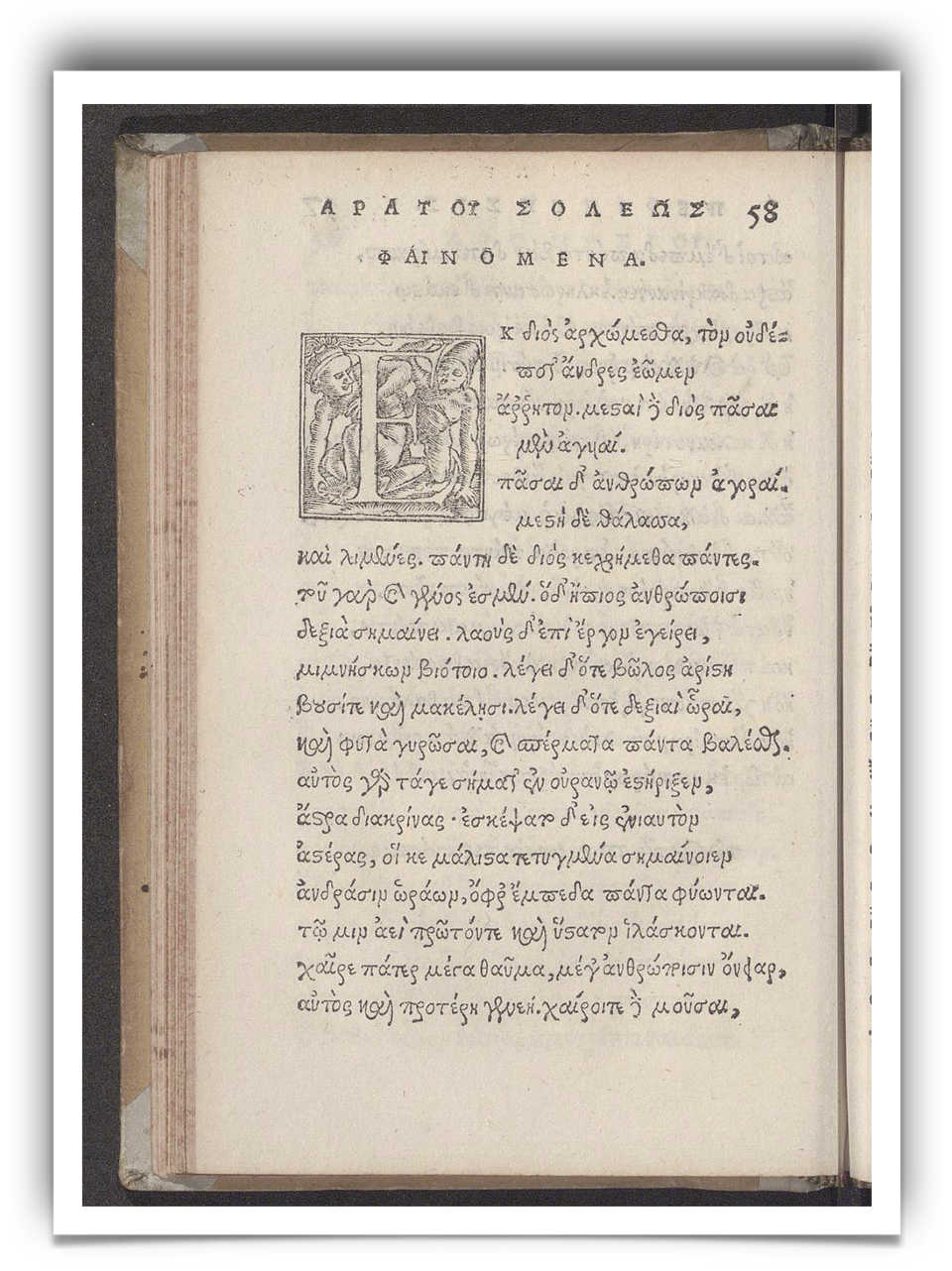
What might we learn from this strategy of Paul? Have you ever considered that the religious or philosophical writings of nonbelievers can be used to point people to the true God as an avenue to the gospel? What books or blogs have you read recently by non-Christians that contain truths that align with biblical teaching?
History
Let’s fast-forward about 1500 years. John Calvin wrote a large work that expanded each time he worked on it. In his “Institutes of the Christian Religion,” Calvin speaks about common grace in the fourteenth section of the second chapter of his second book:
“… hardly anyone is to be found who does not manifest talent in some art. There are at hand energy and ability not only to learn but also to devise something new in each art or to perfect and polish what one has learned from a predecessor.”
What does this section teach us about common grace? This passage teaches us that nearly all people have something new to contribute to an area they have been trained in—even improving what they learned from their teacher.
What have you learned from someone that you could improve? Does this give you confidence that you are indeed important, regardless of your title or status? Name one thing that you really enjoy, then ask God to show you one way that you can help others in that area.
In the fifteenth section, Calvin next talks about what happens if you do not realize the goodness of common grace.
Whenever we come upon these matters in secular writers, let that admirable light of truth shining in them teach us that the mind of man, though fallen and perverted from its wholeness, is nevertheless clothed and ornamented with God’s excellent gifts. If we regard the Spirit of God as the sole fountain of truth, we shall neither reject the truth itself, nor despise it wherever it shall appear, (In despising the gifts, we insult the Giver.)
Another translation of Calvin words the last sentence with more power than the typical academic version. Notice how Calvin connects the gifts and the Giver. How many times have you heard someone warn that we should not value the gifts above the Giver? Is it possible that you could hear it so much that you begin to swing the other way and show unthankfulness by despising God’s good gifts?
Calvin ends this section with one more powerful reflection of humanity.
… shall we count anything praiseworthy or noble without recognizing at the same time that it comes from God? Let us be ashamed of such ingratitude, into which not even the pagan poets fell, for they confessed that the gods had invented philosophy, laws, and all useful arts. Those men whom Scripture 1 Cor. 2:14 calls “natural men” were, indeed, sharp and penetrating in their investigation of inferior things. Let us, accordingly, learn by their example how many gifts the Lord left to human nature even after it was despoiled of its true good.
There’s one more point to learn from Calvin. He recognizes that even ancient pagans were wise in their sciences. For Calvin, he would not have considered it wise to refuse to learn from truth wherever it might be found. Rather, he would admit that wisdom can be found from even those who do not realize where wisdom comes from: the one true God.
In your Christian experience, have you ever heard a wonderful truth from an unlikely person? When that happened, did it cause you to pause on learning more from that person, or did you give God thanks that he uses all people to teach all manner of truths? Even though mankind is in a fallen condition, every human being is still created in the image of God. Knowing this, how might that affect your opinion of those who differ from you? Does understanding the doctrine of common grace help you to humbly learn from those of differing persuasions?
Today
We have seen biblical evidence for God’s common grace. We have seen historical commentary on God’s common grace. Now, let’s finish with a modern example of common grace—God’s goodness to his creatures by allowing them to enjoy his creation.
It is no secret that we are living in a technological world. And, the pace of technology’s innovation is not going to slow down. Our phones are smart, a ten-dollar plug can make the lights in our home smart, and even our watches are smart—even saving people’s live as we saw in our introduction.
While many people may read this Bible study, it is primarily aimed at those in their teenage years. What are you surrounded by that can be used to lead you into temptation in ways your parents could have never imagined? Technology. What are you surrounded by that can be used to deliver you from evil? Technology.
When the Apostle Paul was at the end of his life, he wrote to his son in the faith, Timothy. With only a few days left before he would finally dwell in paradise without being sent back, he asked for a few items.
2 Timothy 4:13⠀13 The cloke that I left at Troas with Carpus, when thou comest, bring with thee, and the books, but especially the parchments.
In your pocket, you have a device that holds more books than the greatest minds of Paul’s day could have ever imagined. You have an unlimited supply of Bible translations, commentaries, dictionaries, and Christian apps. And even if you are not one to spend time reading and studying, that same smartphone can be used to encourage family and friends, to call those who are lonely, to video those who are away, and to remember visually the important times of life. Perhaps a little less significant than human connection, you can use technology to record and remember items that make you a more productive student and worker at school and at your job.
How is that possible? In 2015, smartwatches went mainstream. In 2010, tablets become smarter and friendlier. In 2007, the phone became smart. In the mid-1990s, the computer got a more usable interface with windows instead of blinking prompts. And all of that was possible because the computer became personal in 1984. Bob Dylan sang that “… we can see the Master’s hand, in every leaf that trembles and in every grain of sand.” While he was not writing about computers yet to be invented, every computer chip is made from melted grains of sand. Do you see God’s hand in the grains of sand in the computer chips in the devices that you use every day—hopefully for the glory of God?
And while each of those inventions above surely involved Christian workers, none of them were made by “Christian companies” or for “Christian purposes.” Instead, they were created by people of various religions (or none) to enrich humanity while also adding a few dollars in their bank accounts along the way. Yet, every one of these inventions has been, is, and will continue to be used by Christians for the glory of God.
This week, how will you use one of the greatest gifts of God’s common grace for his glory? You have a device that can compute trillions of operations per second and send that information anywhere in the world in a matter of milliseconds. With that speed and that power, and the command to exhort one another daily (Hebrews 10:25), do you realize you have the greatest opportunity to enable others to learn and obey the commandments of God than any other time in history?
Common grace ≠ Saving grace
Luke 12:16–20⠀16 And he spake a parable unto them, saying, The ground of a certain rich man brought forth plentifully: 17 And he thought within himself, saying, What shall I do, because I have no room where to bestow my fruits? 18 And he said, This will I do: I will pull down my barns, and build greater; and there will I bestow all my fruits and my goods. 19 And I will say to my soul, Soul, thou hast much goods laid up for many years; take thine ease, eat, drink, and be merry. 20 But God said unto him, Thou fool, this night thy soul shall be required of thee: then whose shall those things be, which thou hast provided?
Just because God is good to us does not mean that he is pleased with us. In our fallen condition, we are prone to see God’s blessings as evidence that we have favor with him. And in the Bible Belt, it is even easier for us to fall into that line of thinking. Have you ever seen the goodness of God as “proof” that everything is ok between you and Jesus? Or, have you ever assumed that trouble in this life is “proof” that God no longer loves you?
While we should always be thankful for the goodness of God, we should never think that the goodness of God’s creation surrounding us means that the grace of God’s salvation has forgiven us. As great as the things we see all around us are, they are not eternal. Only the unseen blessing of saving grace will last after this life. When we die, as great as they are, the gifts of God’s common grace (the goodness of his creation to his creatures) will be left on this side of the grave. You can’t carry the gifts of common grace with you, but they are meant to point you to the One who will be with you, giving you contentment, knowing that he will never leave you nor forsake you.
Romans 2:4⠀4 Or despisest thou the riches of his goodness and forbearance and longsuffering; not knowing that the goodness of God leadeth thee to repentance?
Questions, Actions, & Reflection
- Look around you at this moment. Look at your desk, your kitchen, your car, or whoever you are and write three things that you have never told God you are thankful for.
- Look at the closest technology you have near you. Name one thing you have ever done with it that does not glorify God and ask him to forgive you of it.
- Open a Bible app and find an encouraging verse and copy it. Now, scroll through your messages and ask God to show you one person that might be depressed or discouraged. Send that verse to that person.
- Think of something “nonspiritual” that someone has taught you. It might be how to change a tire, balance a checking account, or format a school paper. Pray to Christ, and thank him for the knowledge he has given to people that they have shared with you.
- Think of something that you are really, really, really interested in. Now think back through this lesson and try to connect a biblical or historical truth to whatever it is that you enjoy. Then, think of someone who has the same interests as you. Next time you see them, tell them what God has taught you about the common interest the two of you share.
- The next time you go eat or shopping, when you wait in a line, talk to someone near you instead of passing time on your phone. Ask God to direct your path to someone that you can encourage. Strike up a conversation with someone and try to learn from them. At some point in the conversation, thank the person for their wisdom and see if you can turn the conversation towards Christ, the one who gives wisdom to his creatures.
- Finally, scan the QR code to listen to the song on the first page of our study, “It’s a Beautiful Day.” As you listen to the song, reflect on the joys (sunshine) and the pains (the rain) of the Christian life. For everything good you write down, thank Jesus for his common grace that allows you to enjoy all things. And for everything wrong you write, thank Jesus for his saving grace that allows you to forgive and be forgiven of all things.


 preachertony.com